
Bosphorus Yacht Cruise: 2.5-Hour Small Group Tour with Asian Side Visit in Istanbul
by Velena Travel Yacht Cruises
Choose from 1 available option
How do you want to book?
Book on Viator Confirmed right away, but you pay full price.$116.04Overview
This 2.5-hour yacht cruise offers a relaxed way to see Istanbul from the water, traveling along the Bosphorus Strait that separates Europe and Asia. The tour operates with a small group, providing a quieter atmosphere away from the city noise. A multilingual guide narrates the sights seen on both sides of the waterway. The cruise passes notable landmarks such as the Dolmabahçe Palace, Ortaköy Mosque, Bosphorus Bridge, Rumeli Fortress, and the Maiden's Tower. After sailing through the strait, the yacht docks on the Asian side in the Kanlıca neighborhood. Here, travelers can explore the district known for its traditional yogurt, tea gardens, and a local market. Included in the tour are snacks like savory pastries, small sandwiches, fresh seasonal fruit, bottled water, Turkish coffee served with Turkish delight, and pickup from the Old City or Taksim area. The return drop-off is to either Taksim or Sultanahmet Squares. Alcoholic drinks are not included.
Highlights
What's included
What's not included
Itinerary
Bosphorus Strait
The Bosphorus is a narrow strait in Istanbul, Turkey, linking the Black Sea to the Sea of Marmara. It divides Istanbul's European and Asian sides and is a key route for international maritime traffic. The strait is about 31 kilometers (19 miles) long and ranges in width from around 700 meters (2,300 feet) to 3,700 meters (12,100 feet). Historically, it has been a strategic location for many civilizations, including the Byzantine and Ottoman Empires, and features landmarks like the Maiden's Tower and Dolmabahçe Palace.
Dolmabahce Palace
Dolmabahçe Palace is located on Istanbul's European shore of the Bosphorus and served as the main residence and administrative center for Ottoman sultans in the late 19th and early 20th centuries. Construction began in 1843 and lasted 13 years, commissioned by Sultan Abdulmecid I to replace Topkapi Palace with a more modern European-style building. Designed by Armenian architects Garabet and Nigoğayos Balyan, it incorporates Baroque, Rococo, and Neoclassical styles.
Ortakoy
Ortaköy Square, next to the mosque, is a popular spot for both locals and visitors. It hosts cafes, restaurants, and shops selling handicrafts, jewelry, and artwork. The square provides views of the Bosphorus Bridge, which connects Istanbul's European and Asian sides. Ortaköy is also known for its nightlife, featuring bars, clubs, and live music venues.
Buyuk Mecidiye Camii
Originally built in the 18th century, the Ortaköy Mosque was renovated multiple times, with the current structure completed in 1856. Designed by Ottoman architect Garabet Balyan, it combines Baroque, Neoclassical, and Ottoman architectural styles. Notable features include slender minarets and a large central dome, with interiors decorated with colorful tiles and stained glass windows.
Bosphorus Bridge
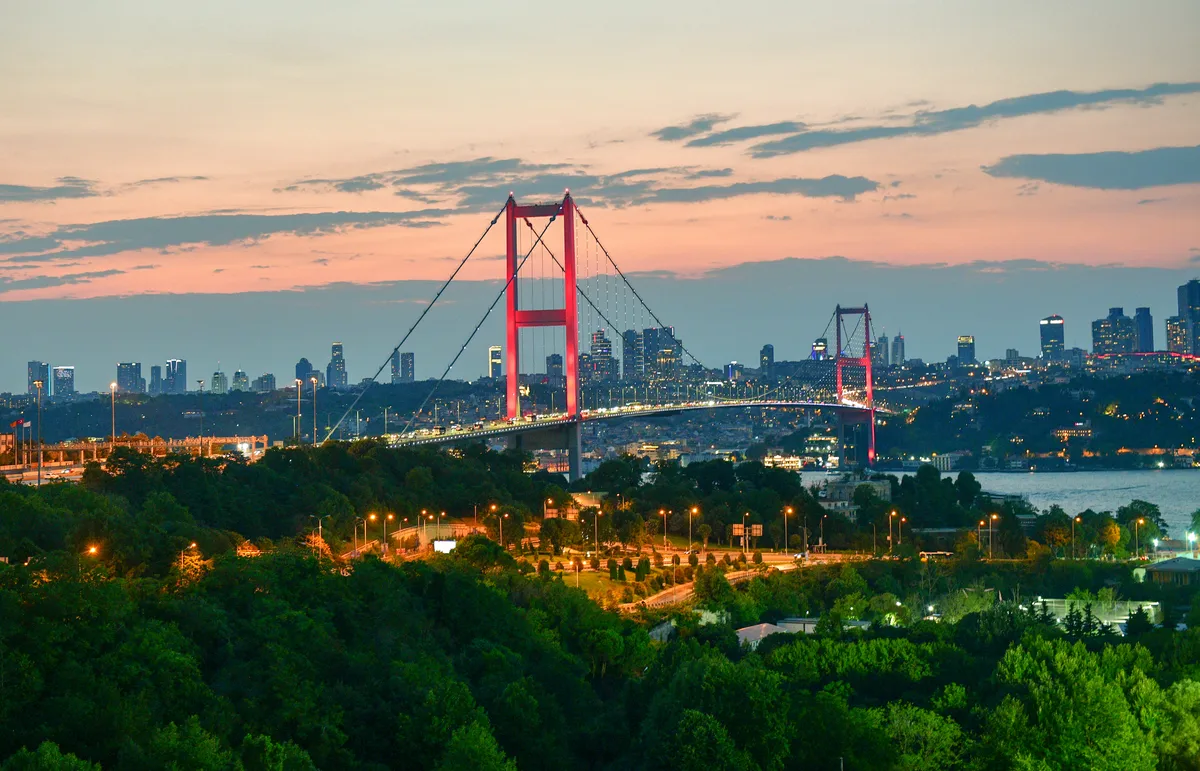
The Bosphorus Bridge is a key transportation link in Istanbul, facilitating vehicle movement between the European and Asian sides. It also offers views of the Bosphorus Strait and city skyline. The bridge has undergone maintenance and renovations to maintain safety and structural integrity and is often featured in images representing Istanbul.
Rumeli Fortress
Rumeli Fortress is a large structure with three main towers and several smaller ones, connected by thick walls. It covers a wide area and provides panoramic views of the Bosphorus and surrounding landscape. Visitors can explore towers, walls, and courtyards that were used for military defense. The fortress hosts cultural events and concerts during summer and offers insights into Ottoman military architecture.
Fatih Sultan Mehmet Bridge
The Fatih Sultan Mehmet (FSM) Bridge is about 1,510 meters long and 39 meters wide, featuring two main towers and eight traffic lanes, four in each direction. It includes pedestrian walkways on both sides. Like the first Bosphorus Bridge, it connects Europe and Asia and has undergone maintenance to ensure safety. It remains an important part of Istanbul's transportation system.
Kucuksu Pavilion
Kanlıca is known for its yogurt, called "Kanlıca Yoğurdu," famous for its creamy texture and tangy flavor. Visitors often enjoy it with powdered sugar or honey. The area has a local market offering fresh produce, delicacies, and handmade items. Kanlıca also features tea gardens and cafes along the waterfront, providing a peaceful atmosphere for walks and relaxation.
15 min
Beylerbi Parki
Construction of Küçüksu Palace started in 1856 and finished in 1857 during Sultan Abdülmecid I's reign. It was used mainly as a hunting lodge and a place for Ottoman sultans and guests to relax and entertain. The palace blends Ottoman and European architectural influences, mainly Baroque and Rococo. It has two main floors and a basement, with a facade decorated with intricate ornaments, colorful tiles, and carvings.
Anadolu Hisarı Fortress
Anadolu Hisarı is a rectangular fortress with towers at each corner, built with stone walls reinforced by battlements. Inside are small buildings including a mosque and a cistern. The fortress is well preserved and open to visitors, who can explore its walls and enjoy views of the Bosphorus. It provides insight into Ottoman military architecture and offers a tranquil setting.
KIz Kulesi
Çengelköy is a historic neighborhood on Istanbul's Asian side along the Bosphorus. It is noted for its traditional Ottoman wooden houses, which are well preserved and feature intricate designs and ornate details, reflecting the architectural heritage of the city. The area is known for its charming atmosphere and waterfront views.
TopkapI Palace
Kız Kulesi, known as the Maiden's Tower or Leander's Tower, stands on a small islet at the southern entrance of the Bosphorus Strait. Its history dates back to ancient times, possibly built as a Byzantine defensive tower around the 5th century. The tower has been reconstructed multiple times and is approximately 23 meters (75 feet) tall, with a cylindrical shape and conical roof, offering panoramic views of the Bosphorus.
Blue Mosque
Topkapi Palace, or Topkapı Sarayı, is a large palace complex in Istanbul that served as the main residence and administrative center for Ottoman sultans for nearly 400 years. Construction began in 1459 under Sultan Mehmed the Conqueror after the conquest of Constantinople. The palace expanded over the centuries into a complex of courtyards, buildings, and gardens.
Hagia Sophia Grand Mosque
The Blue Mosque was built between 1609 and 1616 during Sultan Ahmed I's reign and was designed by architect Sedefkar Mehmed Ağa. It is named for the blue İznik tiles decorating its interior walls. The mosque features a central dome surrounded by smaller domes and semi-domes and has six minarets, which was unusual at the time. The interior includes high ceilings with intricate patterns and calligraphy, along with grand chandeliers.
Galata Koprusu
Hagia Sophia, or Ayasofya, is a historic architectural landmark in Istanbul known for its Byzantine design and cultural significance. Originally built in the 6th century under Emperor Justinian I, it served as an Eastern Orthodox cathedral for nearly 1,000 years. After the Ottoman conquest in 1453, it was converted into a mosque, with minarets added and modifications made for Islamic worship. It remained a mosque for over four centuries.
Suleymaniye Mosque
The Galata Bridge spans the Golden Horn inlet of the Bosphorus, connecting the Eminönü and Karaköy neighborhoods in Istanbul. The original bridge was wooden and built in the 19th century but was rebuilt several times due to fires and ship collisions. The current steel and concrete bridge was completed in 1994.
Misir Carsisi
The Süleymaniye Mosque, or Süleymaniye Camii, is a large mosque in Istanbul and a notable example of Ottoman architecture and Islamic culture. Commissioned by Sultan Süleyman the Magnificent and designed by architect Mimar Sinan, construction began in 1550 and finished in 1557. The mosque was built to commemorate Sultan Süleyman's reign and serves as a grand mosque complex.
Galata Tower
The Spice Bazaar, also called the Egyptian Bazaar or Mısır Çarşısı, is a historic and busy marketplace in Istanbul. Built in the 17th century, it has been a center for trade, especially for spices imported from Egypt. Located in the Eminönü district near the Golden Horn waterfront, it attracts locals and tourists looking to shop for spices, herbs, and various goods.
Galataport
Galata Tower, or Galata Kulesi, is a 67-meter (219 feet) tall tower in Istanbul's Galata neighborhood. Its origins date back to the Byzantine era, likely built in the 14th century as part of Genoese colony defenses. Over time, it served as a watchtower, fire observation point, and prison. Today, it is an observation deck offering panoramic views of Istanbul.
Anadolu Hisari Fort
Galataport is a waterfront development project in Istanbul's Karaköy district on the European side. It is a joint effort between the Istanbul Port Authority and Global Ports Holding. The project redevelops the historic Karaköy port area into a mixed-use complex with commercial, cultural, and recreational facilities, including hotels, restaurants, retail spaces, art galleries, and public areas.
Meeting point
Meeting Point: Dolmabahçe Mosque - https://maps.app.goo.gl/aFk3tXB51tnggpN46 Our staff will be waiting for you holding a VELENA TRAVEL signboard. We kindly ask all guests to arrive at the meeting point 15 minutes before the cruise departure time to ensure a smooth boarding process.
End point
Meeting Point: Dolmabahçe Mosque - https://maps.app.goo.gl/aFk3tXB51tnggpN46 Our staff will be waiting for you holding a VELENA TRAVEL signboard. We kindly ask all guests to arrive at the meeting point 15 minutes before the cruise departure time to ensure a smooth boarding process.
Languages
Cancellation policy
- Cancel at least 24 hours before start for a full refund.
Additional info
More things to do in Istanbul
- Istanbul Airport Round-Trip Private Transfer to Taksim, Fatih, Besiktas, and Sisli Hotels
- Istanbul Bosphorus Daytime or Sunset Sightseeing Cruise with Audio Guide
- Istanbul Full-Day Private Guided City Tour of Hagia Sophia, Blue Mosque, Topkapi Palace, Basilica Cistern, Grand Bazaar
- Bosphorus Dinner Cruise with Folk Dance and Live Performances in Istanbul
- Istanbul Bosphorus Dinner Cruise with Drinks, Live Show and Pickup
- 2-Day Cappadocia Tour from Istanbul with Göreme Cave Hotel and Famous Sites