
Halifax Half-Day Historical Tour Including Titanic and Explosion Sites
by Halifax Titanic Historical Tours
Choose from 1 available option
How do you want to book?
Book on Viator Confirmed right away, but you pay full price.$251.50Overview
Halifax is known for its deep historical connections to the Titanic disaster and the Halifax Explosion of 1917. This half-day tour covers key sites related to these events as well as other important landmarks across Halifax, Dartmouth, and Fisherman's Cove. The tour takes place in a comfortable Ford Transit 350 XLT High Roof van seating between four and ten guests. The guide provides detailed commentary throughout the approximately six-hour trip, using a microphone and speaker system. A large tablet on board allows viewing of guests’ photos and videos to add context to the story. Included are on-board WiFi, bottled water, and air conditioning to ensure comfort during the tour. Stops include the Canadian Museum of Immigration at Pier 21, Harbourside Market, statues of Armando Barbon and Samuel Cunard, the Halifax Waterfront Boardwalk, and the Georges Island National Historic Site with its military history and tunnels. Other key locations are Alexander Keith's Brewery, HMCS Sackville naval memorial, Maritime Museum of the Atlantic, and the Art Gallery of Nova Scotia. The itinerary also visits numerous historic buildings and cemeteries, such as St. Paul's Anglican Church, Halifax City Hall, Province House, Government House, Old Burying Ground, and several cemeteries notable for Titanic and Halifax Explosion victims. The tour includes stops at the Halifax Citadel National Historic Site where the noon gun fires, the Old Town Clock, Point Pleasant Park, Dalhousie University, and sites related to the Halifax Explosion such as the Mont Blanc Anchor Site and Memorial Bell Tower. The tour allows for a 30-minute lunch stop featuring fresh Nova Scotia seafood with views of Halifax (lunch not included). It concludes with visits to Lake Banook and Fisherman’s Cove, a restored fishing village with photographic opportunities. The vehicle seats are assigned by order of booking and the group size is kept small for a focused experience.
Highlights
What's included
What's not included
Itinerary
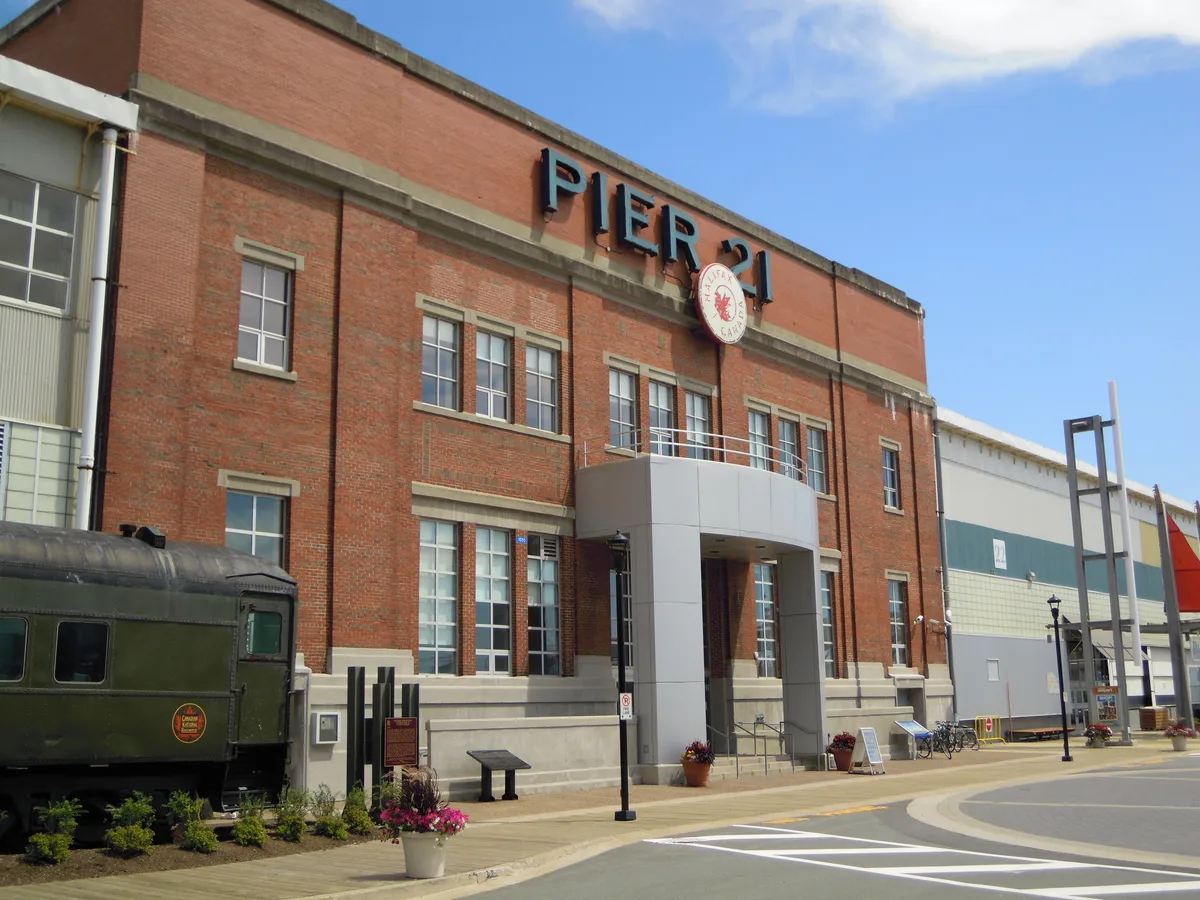
Canadian Museum of Immigration at Pier 21
The guide explains the history of Pier 21, known as the Gateway to Canada.
Harbourside Market
Established by Royal Proclamation in June 1750, one year after Halifax was founded, the market was originally located at the site of today's Bank of Montreal building. For 50 years it operated as a flesh, meat, or cattle market, selling produce and livestock from Acadian farms in the Annapolis Valley and local farms. Incorporated into the City of Halifax in 1848, the market property was conveyed to the city for public use. Since 1750, the market has moved several times and relocated to the Halifax Seaport in 2010, now hosting over 250 vendors.
The Emigrant Statue
This statue by Armando Barbon, an Italian immigrant to Canada, shows Barbon stepping onto a ship while his wife Yole and children wait in the family tree. The inscription notes the pain of separation overcome by faith and hope.
Samuel Cunard Statue
Statue of Sir Samuel Cunard, a British-Canadian shipping magnate born in Halifax who founded the Cunard Line. He was the son of a carpenter and timber merchant who relocated to Halifax after the American Revolution.
Halifax Waterfront Boardwalk
Visit the downtown boardwalk considered the longest in the world, running alongside the second largest natural harbour globally.
Georges Island National Historic Site
Occupied by British military forces from 1750, Georges Island held a strategic position in Halifax Harbour and was central to seaward defences of a major British naval station in the 18th and 19th centuries. In 1794, the island came under the command of Prince Edward during tensions between the UK and the US. It contains Fort Charlotte, two seaward-facing batteries, an underground tunnel complex, and one of Canada’s first fully automated lighthouses. Between 1755 and 1763, during the Acadian deportation, the island served as a prison and holding area for many Acadians. Its network of subterranean tunnels has inspired local folklore.
Alexander Keith's Brewery
Hear about the nearly 200-year history of this Nova Scotia brewery and its founder Alexander Keith. The brewery remains a working facility producing small batch brews inspired by local culture.
HMCS Sackville
Visit HMCS Sackville, the last surviving Allied corvette from World War II, serving as Canada’s Naval Memorial. It is a National Historic Site among 269 corvettes built.
Maritime Museum of the Atlantic
Located on Halifax's historic waterfront, the museum presents Nova Scotia’s maritime history including World War convoys, sailing, steamship eras, and exhibits on the Titanic and Halifax Explosion.
Art Gallery of Nova Scotia
Information is provided about Maud Lewis, a well-known Nova Scotia folk artist.
Historic Properties
Explore three city blocks of Halifax’s oldest surviving waterfront warehouses with Victorian-Italianate façades dating from the late 1700s to early 1800s. This was Canada’s first restoration project of its kind.
Saint George's Round Church
Built in 1800 to serve a growing congregation, this cylindrical wooden church was designed in Palladian style by Edward, Duke of Kent. The guide explains its history and significance.
St. Paul's Anglican Church
Founded in 1749, this is Halifax’s oldest building and the first Anglican cathedral outside England. It contains relics from the 1917 Halifax Explosion including the “Ghost Window.”
Halifax City Hall
Constructed between 1887 and 1890, this building houses Halifax’s municipal government. It is one of Nova Scotia’s oldest and largest public buildings and a National Historic Site since 1997.
Province House
Opened in 1819, Province House is Canada’s oldest legislative building and home to the first elected House of Assembly. It features Regency and Victorian architecture and is both a National and Provincial Historic Site.
Government House
This Georgian style residence has been the home of Nova Scotia’s Lieutenant Governor for over 200 years. It holds a collection of art and antiques reflecting the province’s heritage and is a National Historic Site.
Old Burying Ground
A 0.91 hectare graveyard enclosed by stone and iron fencing, it contains over 1,200 headstones from the 18th and early 19th centuries. It includes a Crimean War monument facing Barrington Street and serves as an urban green space.
St. Mary's Cathedral Basilica
This Gothic Revival cathedral in downtown Halifax is a National Historic Site and the seat of the Archdiocese of Halifax-Yarmouth.
Halifax Court House
Built in 1863 with a 1930 east wing addition, this Italian renaissance style building was designed by William Thomas and built by George Lang. It is a National Historic Site and Provincially Registered Property.
Halifax Central Library
This modern building, designed to resemble a stack of books, has received international attention for its architecture since opening in 2014.
Fort Massey Cemetery
A military cemetery dating back to the 1750s, named after Major General Eyre Massey. It is maintained by Veteran's Affairs Canada and serves as the resting place for soldiers and veterans.
Holy Cross Cemetery
Owned by the Roman Catholic Archdiocese, this cemetery was established in 1843 and replaced St. Peter's Cemetery. About 25,000 people have been buried here, including Prime Minister Sir John Sparrow Thompson.
Holy Cross Cemetery Chapel
Our Lady of Sorrows Chapel, located in Holy Cross Cemetery, was constructed in a single day on August 31, 1843, by over 1,800 people. The chapel features French stained-glass windows dating from the 16th and 17th centuries.
Cathedral Anglican Church Of All Saints
Known as All Saints Cathedral, this Anglican church is the seat for the Diocese of Nova Scotia and Prince Edward Island and was the site of Titanic funeral for William Henry Harrison.
Camp Hill Cemetery
Established in 1844 to replace Halifax’s first cemetery, the Old Burying Ground founded nearly 100 years earlier in 1749. Notable interments include Viola Desmond, Alexander Keith, Joseph Howe, Titanic survivor Hilda Mary Slayter, and John Taylor Wood, a Civil War Confederate naval officer and grandson of President Zachary Taylor.
10 min
+ 16 more places this tour can include
Meeting point
Will pick up Guests at any Downtown Hotel and Cruise Guests will meet Pier 22 Parking lot with sign-on Vehicle your surname
End point
Will pick up Guests at any Downtown Hotel and Cruise Guests will meet Pier 22 Parking lot with sign-on Vehicle your surname
Languages
Cancellation policy
- Cancel at least 24 hours before start for a full refund.