
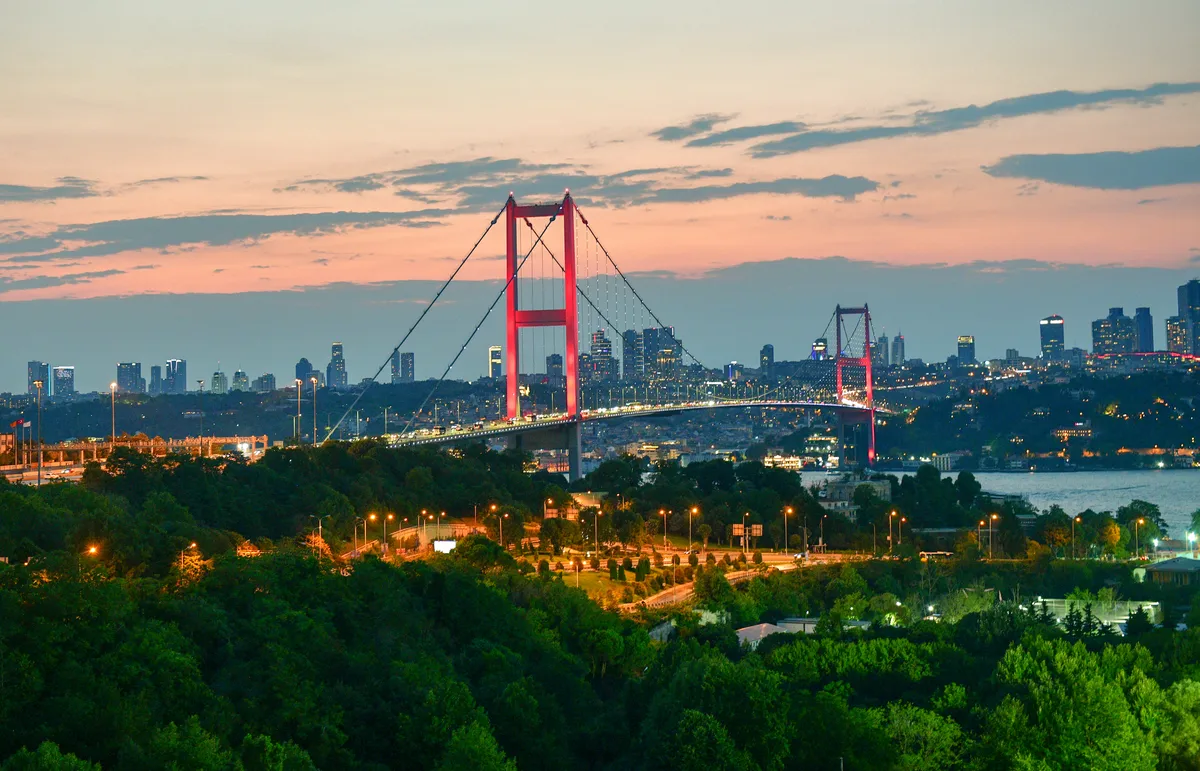
Istanbul Bosphorus Guided Afternoon Cruise on Luxury Yacht with Snacks and Licensed Guide
by Tour Book Turkey
Choose from 1 available option
How do you want to book?
Book on Viator Confirmed right away, but you pay full price.$69.48Overview
This two-hour afternoon cruise on a luxury yacht sails along Istanbul's Bosphorus Strait, offering views of both the European and Asian sides of the city. The Bosphorus connects the Sea of Marmara with the Black Sea and divides Istanbul geographically. The cruise includes commentary from a licensed professional guide who provides information about the city's landmarks and answers questions. Passengers can enjoy light snacks and fresh fruits during the trip. This boat tour operates on Fridays, Saturdays, and Sundays.
Highlights
What's included
What's not included
Itinerary
Bosphorus Strait
The Bosphorus Strait separates Europe and Asia and connects the Sea of Marmara with the Black Sea. It extends about 30 kilometers in a northeast-southwest direction, dividing Istanbul into the European and Anatolian sides. The average depth is 60 meters, with the deepest point reaching 120 meters, and its width varies, reaching up to 3500 meters at the widest point. Surface currents flow from the Black Sea to the Marmara, while underwater currents move from the Marmara to the Black Sea, with occasional surface counter currents.
Dolmabahce Palace
Dolmabahçe Palace is an Ottoman-era palace covering 250,000 square meters in Beşiktaş, Istanbul. Located on the European side at the entrance of the Bosphorus from the Sea of Marmara, it faces the districts of Üsküdar and Kuzguncuk on the Asian shore. The site was once a cove used for anchoring ships and later became a favored residence of the sultanate.
Çırağan Palace
Commissioned by Sultan Abdulaziz and designed by Sarkis Balyan, Çırağan Palace was built on the site of a wooden summer palace from 1800. Completed in 1871, the marble palace covers 80,000 square meters. After Abdulaziz was deposed, he and his family were imprisoned there, and Murat V was also confined for 29 years. The palace served as the House of Parliament after 1908 until a fire in 1910. Later it was used as a stadium before being restored and reopened as a hotel in the early 1990s.
Ortakoy
Ortaköy is a neighborhood in Beşiktaş on Istanbul’s European side along the Bosphorus coast. It includes the Ortaköy and Mecidiye areas, built on slopes near a valley opening to the sea. The district is bordered by Kuruçeşme, Ulus, Levazım, Balmumcu, and Yıldız, with Defterdarburnu to the north. Its bazaar contains shops, cafes, bars, and restaurants that become active after 10:00 am.
Bosphorus Bridge
The Bosphorus Bridge, a suspension bridge completed in 1973, connects Ortaköy on the European side with Beylerbeyi on the Asian side. It was the first bridge built over the Bosphorus and is a key transportation link between the two sides of Istanbul. The bridge is part of the route for the Istanbul Eurasia Marathon and is an important city landmark.
Bebek Park
Bebek is a historic neighborhood on the European shore of the Bosphorus, surrounded by Arnavutköy, Etiler, and Rumeli Hisarı. Its name means 'baby' and refers to its location on the water. Once a popular residential area during the Ottoman period, Bebek today features historic buildings, including Boğaziçi University, waterside mansions, and several upscale restaurants.
Rumeli Fortress
Rumeli Fortress, located in Sarıyer on the European side, was built in 1453 by Sultan Mehmet the Conqueror opposite Anadolu Hisarı on the Asian side. Constructed in just three months, it guarded the narrowest point of the Bosphorus before the conquest of Istanbul. Later it served as a maritime inspection point. The fortress was cleared of wooden houses during 1953 restoration and is now used as an open-air theater and museum.
Fatih Sultan Mehmet Bridge
The Fatih Sultan Mehmet Bridge, Istanbul's second Bosphorus bridge, links Kavacık and Hisarüstü. Construction started in 1986 and it opened in 1988. It ranks as the 14th largest steel suspension bridge worldwide and carries a large portion of cross-Bosphorus traffic along with the Bosphorus Bridge and ferries.
Anadolu Hisari Fort
Anadolu Hisarı is a fortress on the Asian shore in Beykoz at the narrowest Bosphorus point. Built in 1395 by Beyazıt I, it consists of a citadel and outer walls. After Istanbul’s conquest, it became a military hospital, and the surrounding area developed into a residential zone. Restored from 1991 to 1993, it is now an open-air museum with only outer walls accessible, and a road passes through it.
Kucuksu Pavilion
The Küçüksu Pavilion served as a summer palace and hunting lodge for several Ottoman emperors. It is preserved as a museum today.
Beylerbeyi Palace
Beylerbeyi Palace is an Ottoman summer palace built in the 1860s on the Bosphorus shore beneath the Bosphorus Bridge. Designed by Sarkis Balyan, it combines Renaissance, Baroque, and Eastern styles. The two-story stone building covers 2,500 square meters with six halls, 24 rooms, a hamam, and a bathroom. The south side housed the Imperial Mabeyn and the north side the Valide Sultan’s apartment. The palace grounds include a large garden and a lily pond.
KIz Kulesi
Built by the Genoese in 1348, the nine-story Galata Tower is 66.90 meters tall and was the tallest building in the city at that time. It has served as a fire observatory and jail during the Ottoman era. In 1632, Hezarfen Ahmet Çelebi famously glided from its top across the Bosphorus using wings he made. The tower’s conical roof was destroyed in 1875 and restored in the 1960s, when the wooden interior was replaced with concrete. It now has a restaurant and café on its upper floor and is open to the public.
Galata Koprusu
The Galata Bridge spans the Golden Horn and dates back to 1845. It has been rebuilt several times, most recently after a fire in 1992. The current bridge supports tramway and pedestrian traffic above, with restaurants, cafés, and hookah lounges below. It is a central location for fishing, street vendors, and ferry dockings, and offers views of daily life in Istanbul.
Galata Tower
The Maiden's Tower (Kız Kulesi) is located on a small island about 200 meters from the shore of Üsküdar and is part of the Bosphorus skyline. A well-known legend tells of a sultan who built the tower to protect his daughter from a prophecy that she would be killed by a snake bite on her 18th birthday. Despite the protection, she was bitten by a snake hidden in a basket of fruit given to her on that day and died in her father's arms. The tower’s name refers to this story.
Meeting point
We will meet in front of the gas station TÜRKİYE PETROLLERİ next to Kabataş Pier.
End point
We’ll meet at Kabataş Square, near the glass elevator (the lift with the M sign), with our board: GOLDEN CITY TOURS.
Languages
Cancellation policy
- Cancel at least 24 hours before start for a full refund.
Additional info
More things to do in Istanbul
- Istanbul Airport Round-Trip Private Transfer to Taksim, Fatih, Besiktas, and Sisli Hotels
- Istanbul Bosphorus Daytime or Sunset Sightseeing Cruise with Audio Guide
- Istanbul Bosphorus Dinner Cruise with Turkish Night Show and DJ
- Istanbul Private Car Hire with Driver Half- and Full-Day Option from Hotel or Apartment
- Aga Hamami Turkish Bath in Istanbul
- Istanbul Airport Transfer by Private or Shared Minivan