



Nanjing Presidential Palace + Grand Bao'en Temple + Mount Niushou + Confucius Temple One-Day Tour
Choose an option
Prices for Sat 14 Nov
- Admission to attractions
- Chinese-speaking guide
Not included: Audio guide; Hotel pick up and drop off; Transport; Accommodation; Meals and beverages; Other personal expenses
Ticket: -1
Overview
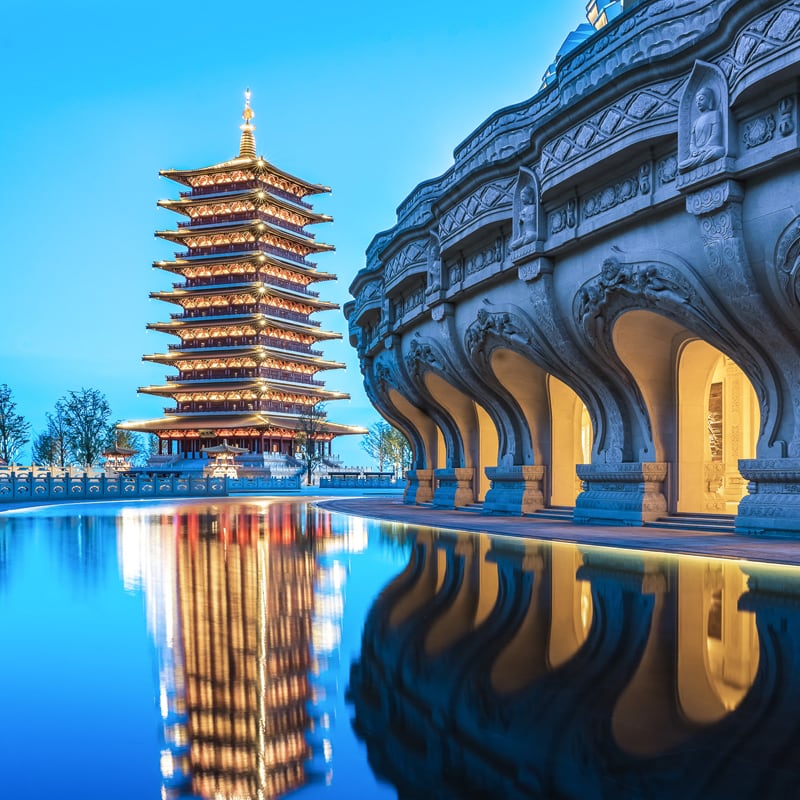
The Presidential Palace, located on Changjiang Road in Nanjing, has witnessed multiple historical periods. From the residence of Zhu Gaoxu, the second son of Zhu Yuanzhang, to the Qing Dynasty's Governor-General of Liangjiang, the Heavenly King's Palace of the Taiping Heavenly Kingdom, and then the Presidential Palace of the Republic of China, it is an important historical site that has witnessed the vicissitudes of China's nearly six hundred years. Grand Bao'en Temple is one of the oldest Buddhist temples in Chinese history. Its predecessor was Jianchu Temple and the Asoka Pagoda, built during the Chiwu period of the Eastern Wu Dynasty. It was rebuilt by Zhu Di, the Ming Chengzu Emperor, to commemorate the Ming Taizu Emperor Zhu Yuanzhang and Empress Ma. It is grand in scale, and the glazed pagoda was praised as one of the "Seven Wonders of the Medieval World." Today, the Grand Bao'en Temple Heritage Park is a Buddhist cultural mecca that integrates heritage protection, cultural inheritance, and tourism. Niushou Mountain, known as "a new world heritage of Buddhist culture and a new landscape of contemporary art and architecture," integrates numerous characteristic attractions such as the Fo Ding Palace and Fo Ding Pagoda. The natural scenery complements the humanistic heritage, fully demonstrating the charm of Jinling (Nanjing). Nanjing Confucius Temple is a historical and cultural site centered on the Confucius Temple ancient building complex, with the ten-mile Inner Qinhuai River as its axis and the Ming City Wall as its bond, connecting numerous cultural relics and historical sites. It is the birthplace of the highest institution of learning in the country and a gathering place for outstanding talents.
Highlights
What's included
What's not included
Cancellation policy
- Free cancellation with 24 hours' notice.
Additional info
More things to do in Nanjing
- Private one-day tour of Niushou Mountain, Meiling Palace in Nanjing
- MELAND Nanjing Jianye Wuyue Plaza Store
- Qixia Mountain Scenic Area
- Nanjing Private Half-Day Tour: Jiming Temple, Nanjing City Wall, Xuanwu Lake
- MELAND CLUB Nanjing Longhu Hexi Tianjie Branch