
Rome VIP Private Tour (3, 5, or 8 Hours) with Colosseum and Vatican Museums
by Limousine Service in Italy
Choose from 5 available options
How do you want to book?
Book on Viator Confirmed right away, but you pay full price.$1,111.58Overview
This private and customizable VIP tour in Rome lasts between three and eight hours, depending on your choice. A licensed guide and a chauffeur will pick you up from your hotel, Airbnb, train station, airport, or the port of Civitavecchia (10-hour tour only from Civitavecchia). The transport is provided in a luxury Mercedes van or golf cart. At each stop, the guide leaves the vehicle to walk with you while explaining the sights in detail. The tour covers Rome's main archaeological and artistic landmarks. The 3- or 5-hour options include the Colosseum, Roman Forum, Palatine Hill, and other central locations. The 8-hour tour adds the Vatican Museums and Sistine Chapel. The guide helps you choose which parts of the Vatican collections to visit and explains key works such as Michelangelo’s Last Judgment and La Pietà. The Sistine Chapel is viewed in silence without photography. You will also visit St. Peter's Square, but entrance to St. Peter's Basilica is not included due to ticketing rules. The tour is private with no other groups combined. Tickets for museums and monuments are not included but can be purchased on request for an additional cash fee. The guide will carry your tickets if arranged beforehand. After each visit, you return to the vehicle to continue to the next site or to complete the tour. The tour's route and timing can be adjusted by contacting the operator in advance or speaking with the guide on the day.
Highlights
What's included
What's not included
Itinerary
Vatican Museums
Included only in the 8-hour tour. The Vatican Museums contain extensive collections of statues, paintings, sarcophagi, and mosaics gathered by the Popes since the Renaissance. Visitors can select which sections to focus on before walking through the corridor leading to the Sistine Chapel. Highlights include Michelangelo's frescoes The Last Judgment and The Genesis, and his marble sculpture La Pietà. The guide provides detailed commentary throughout the visit. After the museum, guests meet the driver to continue or conclude the tour.
120 min
Sistine Chapel
Included only in the 8-hour tour. Built by Pope Sixtus IV in the late 15th century, the chapel features frescoes by artists such as Perugino, Girlandaio, Botticelli, and Michelangelo, who painted the ceiling and The Last Judgment. Inside, talking, photography, and video recording are prohibited. The guide allows enough time to observe the artwork before leading guests to the entrance of St. Peter's Basilica.
30 min
St. Peter's Square
This famous Baroque square is known for the papal conclave announcements and is framed by Bernini's colonnades symbolizing Peter’s embrace of the faithful. The center features an ancient Egyptian obelisk that originally stood in Emperor Nero’s circus. The tour concludes here with final comments from the guide.
10 min
Colosseum
Included in the 5- and 8-hour tours. The Colosseum was the largest and most sophisticated amphitheatre of the ancient world, built between A.D. 70 and 72 under Emperor Vespasian. It hosted gladiatorial contests and public spectacles, and remains a symbol of Rome.
60 min
Roman Forum
The Roman Forum was the political and social center of ancient Rome. Founded in the 8th century BC, it served as the hub from which the Romans expanded their empire across Europe.
10 min
Palatine Hill
The central and oldest of the Seven Hills of Rome, Palatine Hill is the site of the city’s original settlement and later imperial palaces starting with Augustus. It covers between 63 and 131 acres depending on ancient records. Today it is mainly an open-air museum with a collection of finds displayed in the Palatine Museum.
Pantheon
Constructed originally in 25 BC by Marcus Agrippa and rebuilt by Emperor Hadrian about 150 years later, the Pantheon is famous for its large open dome. Since the 7th century, it has functioned as the Basilica of Santa Maria ad Martyres.
15 min
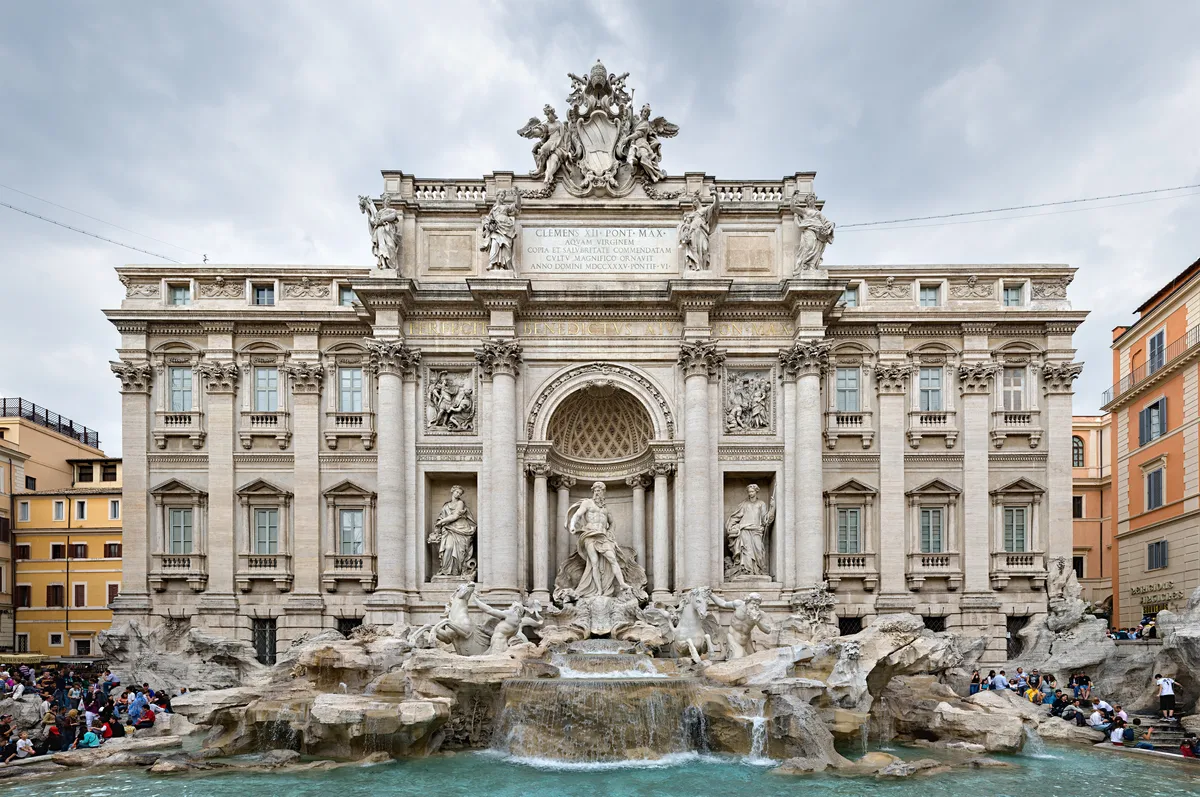
Trevi Fountain
Located at the meeting point of three streets, the Trevi Fountain marks the end of the Acqua Virgo aqueduct. It is one of Rome’s most famous fountains, known for the tradition of throwing coins to ensure a return to the city.
15 min
Circo Massimo
The Circus Maximus was an ancient stadium for chariot racing and mass entertainment, situated between the Aventine and Palatine Hills. It was the largest stadium in Rome and its empire.
5 min
Piazza del Campidoglio
The smallest but most politically and religiously important of Rome’s seven hills, Capitoline Hill became a symbol of Rome’s power. From its summit, visitors can view the ruins of the Roman Forum, including temples, basilicas, and arches that represent centuries of Roman rule.
15 min
Piazza Venezia / Ancient City
Piazza Venezia is a central square in Rome where key roads intersect, including Via dei Fori Imperiali and Via del Corso. It is named after Palazzo Venezia, built by Cardinal Pietro Barbo next to the church of Saint Mark.
10 min
Via Del Corso
A main street in Rome’s historic center, Via del Corso is about 1.5 kilometers long and approximately 10 meters wide. The northern part is pedestrianized, while the rest accommodates two traffic lanes and narrow sidewalks.
Spanish Steps
The Spanish Steps in Rome rise between Piazza di Spagna at the bottom and Piazza Trinità dei Monti at the top, dominated by the Trinità dei Monti church. The monumental staircase has 135 steps and was constructed from 1723 to 1725 using 20,000 scudi left by French diplomat Étienne Gueffier. It connects the Trinità dei Monti church, supported by the Bourbon kings of France, and the Spanish Embassy near the Holy See at Palazzo Monaldeschi at the base.
15 min
Piazza Navona
Built over the ruins of Emperor Domitian’s stadium from the first century, Piazza Navona is a Baroque square featuring Bernini’s Fountain of the Four Rivers at its center. It was commissioned by Pope Innocent X and his family, the Pamphili.
10 min
Campo De' Fiori
A rectangular square south of Piazza Navona, Campo de’ Fiori means 'field of flowers.' It was a meadow during the Middle Ages and previously an unused space in Ancient Rome between Pompey’s Theatre and the Tiber River.
15 min
Languages
Cancellation policy
- Cancel at least 24 hours before start for a full refund.
Additional info
More things to do in Rome
- Rome Small Group Walking Tour Between Holy Doors and Basilicas
- Rome Food Experience 3-Hour Walking Tour with Dinner, Drinks, Max 6 People or Private Option
- Rome Classic Vespa Tour with Private Driver and Hotel Pickup
- Rome Borghese Gallery Skip-the-Line Ticket with Downloadable Audioguide
- Papal Audience with Pope Leo XIV in Vatican City
- Rome Private Arrival Transfer from Fiumicino Airport (FCO)