
London Black Taxi Tour with Private Guide, 4 Hours, Pickup and Drop Off Included
by London Sightseeing Tours
Choose from 1 available option
How do you want to book?
Book on Viator Confirmed right away, but you pay full price.£460Overview
This 4-hour tour takes place in a London Black Taxi, providing access to parts of the city that larger buses and coaches cannot reach. The tour uses mainly TXE model Black Taxis, which are hybrid vehicles with wheelchair accessibility and room for up to six passengers. Larger groups can be accommodated by booking multiple taxis. The taxi is spacious, air-conditioned, and features large windows plus a glass roof for wide views of the city. The tour route is flexible and can include short walks if desired. An accredited guide will pick up guests from their chosen location within 5 miles of Trafalgar Square and will either return them to their hotel or a location of their choosing. Stops on the tour include prominent London landmarks such as Wellington Arch, the Houses of Parliament, Big Ben, 10 Downing Street, Westminster Abbey, Tower Bridge, Victoria Embankment, and St. Paul's Cathedral. Each stop offers historical and architectural insights, with the guide providing detailed commentary throughout the journey.
Highlights
What's included
What's not included
Itinerary
Wellington Arch
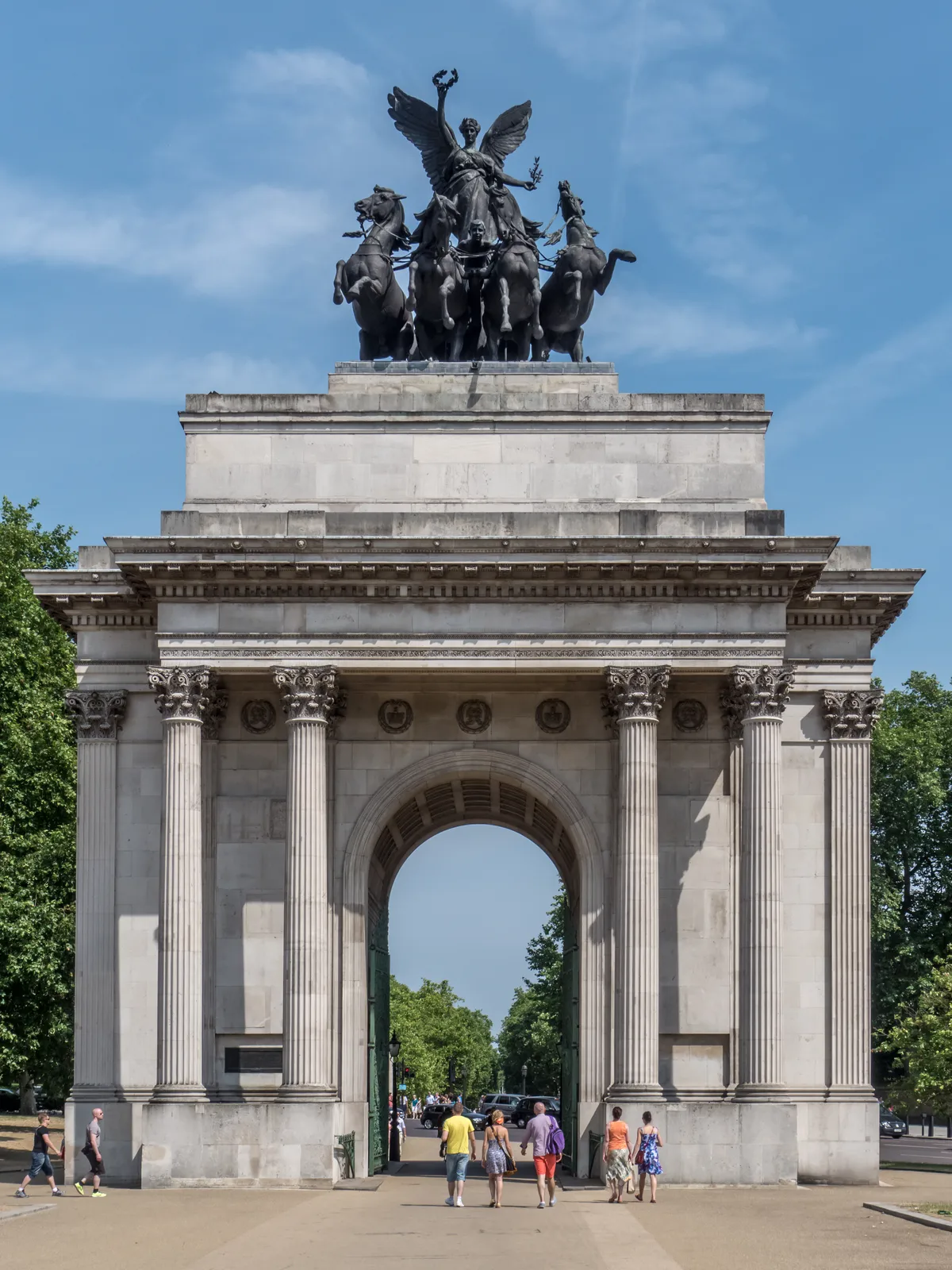
Opposite Apsley House, the home of the Duke of Wellington dating from 1825, stands Wellington Arch. The arch was moved slightly to serve as an outer gate for Buckingham Palace and now faces Constitution Hill. The original large statue of Wellington was removed after his death and replaced by a smaller one. The current quadriga statue, placed atop the arch in 1912, is among the largest equestrian statues in Europe and features Nike, the Goddess of Victory.
Houses of Parliament
The site originally housed a royal palace recorded since the 11th century under William the Conqueror. After a fire in 1512 and complete destruction in 1834, only the Crypt, Jewel Tower, and Westminster Hall (dating from 1097) remain from earlier buildings. The current Houses of Parliament were rebuilt between 1834 and 1870 by Augustus Pugin and Charles Barry and contain the House of Commons and House of Lords on the north bank of the River Thames.
Big Ben
Big Ben refers to the Great Bell of the clock located at the north end of the Palace of Westminster, but is commonly used for the bell, clock, and clock tower. The tower was originally called The Clock Tower and was renamed The Elizabeth Tower in 2012 for Queen Elizabeth II's Diamond Jubilee. Designed by Augustus Pugin in Gothic Revival style, it opened in 1859 and remains a well-known London landmark.
10 Downing Street
Downing Street houses the official residences of the UK Prime Minister at number 10 and the Chancellor of the Exchequer at number 11. Built in 1680 by Sir George Downing, it lies between the Houses of Parliament and Trafalgar Square, near Whitehall.
Westminster Abbey
Known formally as the Collegiate Church of Saint Peter, Westminster Abbey is mainly Gothic and has hosted every coronation since William the Conqueror. It has also been the site of sixteen royal weddings and the burial place of many monarchs. Founded in 960 AD, it underwent major alterations in the 13th century under King Henry III and further rebuilding in 1517 during King Henry VIII's reign. The two towers visible today were added in the 18th century by Nicholas Hawksmoor.
Tower Bridge
London's bridges trace back to Roman wooden bridges. The medieval Old London Bridge, built between 1176 and 1209, was the longest inhabited bridge in Europe at nearly 906 feet and contained shops, houses, and a chapel. The current London Bridge is the third stone bridge. Tower Bridge, built from 1886 to 1894, is a combined bascule and suspension bridge known as the Wonder Bridge. Nearby Albert Bridge connects Chelsea to Battersea and is famous for its lighting and the sign advising troops to break step due to its instability.
Victoria Embankment
The Victoria Embankment extends along the north bank of the River Thames from the Palace of Westminster to Blackfriars Bridge. It is known for memorials such as The Battle of Britain, retired vessels like H.M.S. President, and public gardens including Victoria Embankment Gardens. Constructed between 1865 and 1870 under Joseph Bazalgette, it narrowed the River Thames significantly.
St. Paul's Cathedral
A building has stood on this site since 604 AD under Bishop Mellitus, with four cathedrals in total. Old St. Paul's was constructed between 1087 and 1314 and was the largest building in the UK until it was destroyed in the Great Fire of London in 1666. The current cathedral, built from 1675 to 1710 in English Baroque style by Christopher Wren—who is buried beneath the 365-foot-high dome weighing 65,000 tons—stands on Ludgate Hill, the highest point in the City of London. It functions as the Anglican Cathedral and the seat of the Bishop of London and Mother Church of the Diocese of London.
Meeting point
At point arranged and will be showing a nameboard.
End point
At point arranged and will be showing a nameboard.
Languages
Cancellation policy
- Cancel at least 24 hours before start for a full refund.
Additional info
More things to do in London
- The Postal Museum Admission Ticket in London
- Windsor Castle, Stonehenge and Bath Day Trip from London Spanish
- London Buckingham Palace 2.5-Hour Tour with Entrance Ticket and Changing of the Guard
- London by Night 90-Minute Open Top Bus Tour with Live Guide
- Oxford, Stratford-upon-Avon, Cotswolds & Warwick Castle Day Trip from London
- Small Group Stonehenge, Bath and Secret Place Tour from London